
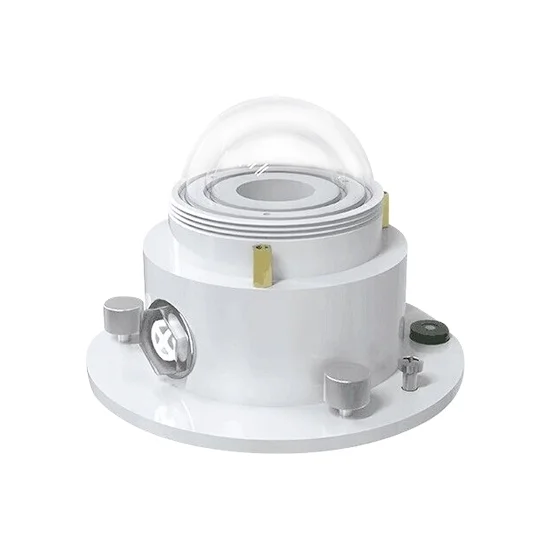
Description
The UV sensor operates on 10V to 30V DC and uses the 485 ModBus-RTU protocol. It works in temperatures from -40°C to 80°C and measures solar radiation from 0 to 2000W/m² with a spectral range of 0.3 to 3μm. The sensor is accurate, with a sensitivity of 7 to 14 μV·W⁻¹·m⁻², a response time of ≤30 seconds, and minimal zero drift, making it ideal for outdoor use.
Specification
| Model | ATO-RS-TBQ-*-AL |
| Power Supply Range | 10V~30V DC |
| Output Method | 485 (Standard ModBus-RTU Protocol)/4-20mA/0-5V/0-110V |
| Power Consumption | 0.2W |
| Transmitter Operating Temperature & Humidity | -40°C~80°C, 0%RH-95%RH (Non-condensing) |
| Sensitivity | 7~14 μV·W⁻¹·m⁻² |
| Impedance | 200-400Ω |
| Response Time (95%) | ≤30s |
| Non-linearity Error | ≤±3% |
| Directional Response Deviation | ≤±30W/m² |
| Temperature Influence Deviation | ≤±3% (-30°C~+50°C) |
| Spectral Range | 0.3~3μm |
| Measurement Range | 0-2000W/m² |
| Resolution | 1W/m² |
| Accuracy | ≤±3% |
| Annual Stability | ≤±3% |
| Residual Response Deviation | ≤±5% |
| Tilt Response Deviation | ≤2% |
| Zero Drift | ≤6W/m² |
| Latitude Accuracy Range | 0~55° |
| Polar Region Compensation Range | ±25° (For Northern Hemisphere) |
| Equatorial Radius | Φ400 |
Features
- 95% Transmittance Rate: The ultraviolet sensor uses sapphire glass, ensuring durability and excellent light transmittance. It achieves a transmittance rate of up to 95%, effectively preventing environmental factors from interfering with internal components.
- High-Precision Sensor Element: The UV sensor employs a thermopile with a black coating that absorbs a high percentage of solar radiation, providing a quick response time. It features small error margins, temperature compensation, and highly accurate measurements.
- Radiation Response: It converts absorbed solar radiation into a thermoelectric voltage, allowing accurate measurement of solar radiation levels.
- All-Aluminum Housing: The uv light sensor is built with a full aluminum exterior, offering IP67 protection rating. The housing is resistant to rain, snow, oxidation, and corrosion, ensuring long-lasting performance in harsh environments.
Dimension (Unit: mm) Application Product Maintenance
- The glass cover should be kept clean and frequently wiped with a soft cloth or fur to maintain clarity.
- Ensure no water enters the glass cover. In case of prolonged weather conditions like heavy rain, snow, or ice, it is recommended to cover the equipment to protect it.
- Periodically check the desiccant inside the dryer to ensure it has not become damp. If the desiccant changes color from orange to a darker shade, it indicates moisture absorption. Replace it immediately or remove and dry the desiccant before reusing it.
- After two years of use, the equipment’s sensitivity should be recalibrated by the manufacturer or a certified metrology department.
Tips: What is the significance of the spectral range for solar radiation measurement?
The spectral range of 0.3 to 3μm covers both the ultraviolet (UV) and infrared (IR) regions of the electromagnetic spectrum, making the UV sensor versatile for measuring a wide range of solar radiation wavelengths. This broad range is crucial because it captures most of the solar energy that reaches the Earth’s surface. The UV portion of the spectrum (typically 0.3 to 0.4μm) is important for applications like UV index monitoring and understanding the effects of UV radiation on materials and organisms. The infrared portion (0.7 to 3μm) is essential for measuring the heat or thermal energy associated with solar radiation, which is critical for solar energy applications and climate studies. By covering this range, the sensor provides a comprehensive measurement of solar radiation, making it suitable for use in both meteorological stations and solar energy monitoring systems.

Reviews
There are no reviews yet.