
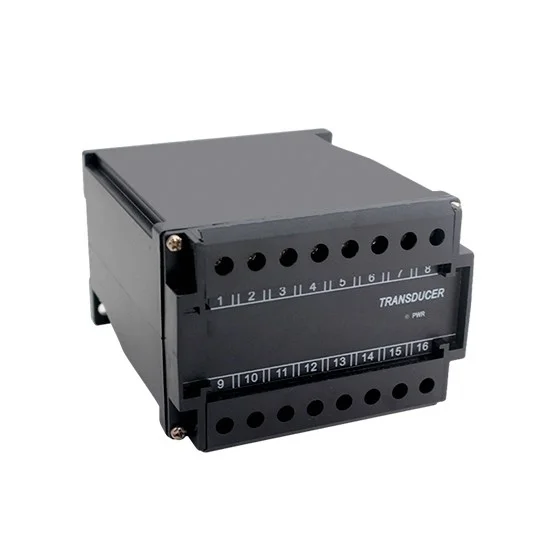
Description
The 3-phase AC voltage transducer is sold at a low price, with an accuracy of 0.2/0.5, a response time of less than 400ms, and an output ripple of ≤0.5% RO peak. The three-phase AC voltage transducer is designed for different environments, and the storage conditions are a temperature of -20~70℃ and a relative humidity of less than 70%.
Specification
| Model | ATO-PT-HDB |
| AC Voltage Input | 0-120V,0-300V,0-450V,0-600V, customization (optional) |
| Input Load | Voltage transformer PT: ≤0.1VA |
| Allow Overload | Voltage×1.2 times the nominal value lasts |
| Accuracy | Average measurement, 0.5 True RMS measurement, 0.5 Average measurement, 0.2 True RMS measurement, 0.2 (optional) |
| Response Time | ≤400ms |
| Output Channel | 1 channel, 2 channels, 3 channels, 4 channels (optional) |
| Output Voltage | 0-10V, 0-5V, 1-5V (load resistance = input voltage/10mAdc) |
| Output Current | 0-1mA, 0-10mA, 0-20mA, 4-20mA (Load resistance=10VDC/output current) |
| Other Output | RS485, customization |
| Output Ripple | ≤0.5% RO peak |
| Work Environment Temperature and Humidity | 0~50℃/less than 80% relative humidity (no condensing) |
| Storage Conditions Temperature and Humidity | -20~70℃/less than 70% relative humidity (no condensation) |
| Aux.power Supply | DC12V, DC24V, AC220V, DC220V, AC110V, DC110V, 2-wire circuit power supply (optional) |
| Isolation | Input/output/power supply/shell |
| Power Consumption | DC about 3W, AC about 4VA |
| Material of Shell | ABS fireproof material |
| Weight | About 450 grams |
| Compressive Strength | AC2kVrms/min |
| Insulation Resistance | >100MΩ at DC500V |
| Dimensions | 120(L)× 110(W)× 75(H)mm |
| Installation Method | 35mm standard guide rail or fixed on the cabinet |
Dimension (Unit: mm)
Calibration Fine Tuning
PWR: Power indicator
SPAN: Calibration full scale potentiometer
ZERO: Zero potentiometer
Wiring
Tips: Use and maintenance of power transducer
- Regular calibration: After long-term use, the sensor may drift. Regular calibration is recommended to ensure accurate measurement.
- Check the connection terminals: After long-term operation, the terminal screws may loosen, resulting in unstable signals. Check and tighten them regularly.
- Avoid overload: Make sure the input signal does not exceed the rated range to prevent damage to the sensor or increase in measurement error.
- Prevent moisture and high temperature: Excessive ambient temperature and humidity may affect the life of the circuit board. Keep it ventilated and dry.
Reviews
There are no reviews yet.