
Description
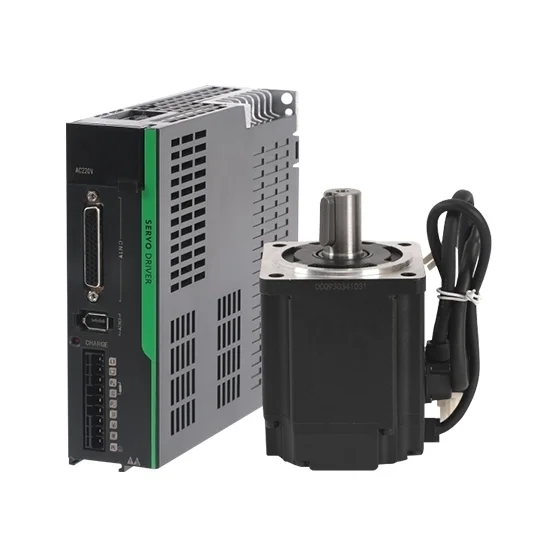
200 watt AC servo motor kit, 3000 rpm servo system combines precise motion control, overload capability, and flexible compatibility in a compact design. The servo driver supports overload and overheat protection for stable long-term operation. Suitable for robotics, laser cutting machines, and automated assembly lines. Buy this AC servo motor and drive set for reliable automation control.
Specifications
| Servo Motor | ||
| Model | ATO-K6201EN2LL5SH / ATO-K6201EN2LL5SA | ATO-K6201EA2LL5SH / ATO-K6201EA2LL5SA |
| Type | Without Brake | With Brake |
| Rated Power | 200W | |
| Rated Current | 1.7A | |
| Rated Torque | 0.64 N·m | |
| Rated Speed | 3000 r/min | |
| Pole Pairs | 5 pole pairs | |
| Rated Voltage | 220V | |
| Peak Torque | 1.91 N·m | |
| Max Speed | 6000 r/min | |
| Weight | 0.8 kg | 1.1 kg |
| Servo Driver | ||
| Driver Model | ATO-K3S-1R8-11 (Click to see the drive manual) | |
| Continuous Output Current | 1.8 A | |
| Peak Output Current | 5.4 A | |
| Matched Motor Power | 100W / 200W | |
| Power Supply | Single-phase AC200~230V, 50~60Hz | |
| Brake Processing Function | No built-in braking resistor | |
| Encoder | 17-bit / 23-bit single-turn / multi-turn absolute | |
| Speed Control Range | 1~6000 rpm | |
| Control Modes | Quadrature pulse control, dual-pulse control, pulse + direction control | |
| Torque Control Accuracy | ±2% | |
| Overload Capacity | 3 times | |
| Analog Input | 1 channel input( -10V~+10V) | |
| Digital Inputs (DI) | 4 inputs | |
| Digital Outputs (DO) | 2 outputs | |
| Z-Signal Output | Adjustable output width |
Features
Servo Motor
- High Dynamic Response: This servo motor adopts advanced manufacturing and optimized magnetic circuit design to reduce magnetic loss and torque ripple, ensuring high dynamic response.
- Fast Start and Stop Response: The short response time of this servo motor, combined with the servo drive, supports millisecond-level acceleration and deceleration, ideal for high-frequency reciprocating motion.
- Low Vibration and Low Noise: This servo motor features a 10-pole rotor, 12-slot stator, optimized magnetic circuit, resonance suppression, notch filter algorithms, and automatic rigidity gain adjustment. These features effectively reduce cogging effect and torque ripple, enabling smoother low-speed and constant-speed operation with low vibration and noise.
- Long Service Life and Durability: Built with high-quality materials and precision manufacturing, this servo motor is designed for long-term continuous operation.
Servo Drive
- Precise Motion Control: This servo drive utilizes advanced software algorithms and a high-performance hardware platform to deliver accurate position, speed, and torque control with fast response and strong dynamic adjustment, making it suitable for high-precision industrial applications such as robotic joint control.
- Stable and Reliable Operation: This servo drive supports overload and overheat protection and features an enhanced conformal coating for harsh industrial environments, ensuring stable and reliable long-term operation.
- High Efficiency and Energy Saving: By optimizing the motor magnetic circuit, this servo drive improves overall efficiency, reduces temperature rise, and enhances energy-saving performance.
- Flexible Compatibility: With support for multiple communication protocols, this servo drive enables seamless integration with PLCs, CNC systems, and other host controllers.
Dimension(unit: mm)
Without Brake
With Brake
Wiring Diagram
Package Include
Tips:How to solve servo motor overheating issues?
Servo motor overheating is commonly caused by overload operation, improper parameter settings, insufficient ventilation, excessive acceleration/deceleration frequency, or unstable mechanical loads. To prevent overheating, the first step is to ensure the motor is correctly sized for the application and not running beyond its rated torque or continuous duty cycle for extended periods. Proper tuning of the servo drive is also important, as excessively high gain settings, frequent rapid starts and stops, or unstable speed control can increase current fluctuation and heat generation. Maintaining good ventilation around the motor and drive, cleaning dust buildup, and avoiding high ambient temperatures help improve heat dissipation efficiency. In addition, reducing mechanical friction, checking bearing condition, and ensuring smooth load transmission can lower unnecessary motor stress. Regular inspection of wiring, encoder feedback, and cooling systems can further help maintain stable operation and prevent excessive temperature rise during continuous industrial use.
Reviews
There are no reviews yet.