
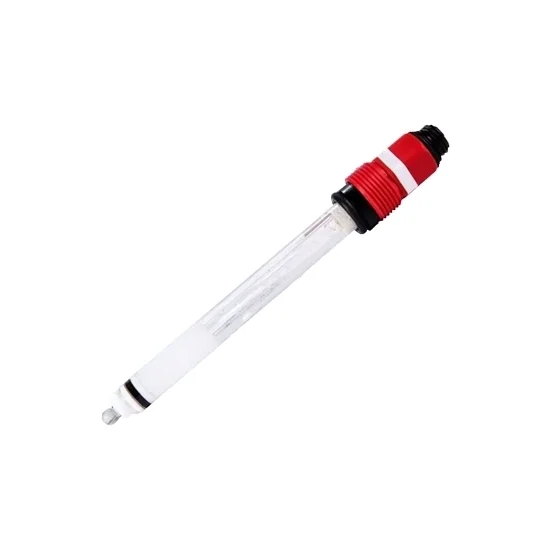
Description
Industrial pH Glass electrode with PTFE ring diaphragm and solid state reserve salt ring design, measurement environment 0~ 135°C and material pressure resistance up to 10Bar. Usually apply in industrial wastewater engineering.
Specification
| Model | ATO-SUP-pH5022 |
| Measuring Range | 0-14pH |
| Temperature Range | 0-135°C |
| Withstand Voltage | 10Bar |
| Thread | PG 13.5 |
| Shell Material | PPS/ PC/ PTFE |
| Storage Temperature | -5~30°C |
| Zero potential point | 7±0.5 pH |
| Conversion cofficient | > 96% |
| Thread Connection | K8S |
| Pressure | 1~6Bar at 25℃ |
| Probe Type | Plug-in |
| Processing Customization | Yes |
Details
Feature
- Made of high toughness WU glass material, pH probe glass electrode measurement environment temperature in 0~ 135°C and material pressure resistance up to 10Bar.
- Compatible with many working conditions, pH meter probe is equipped with high-quality PC material storage sheath.
- pH meter electrode is all-round protective electrode with built-in saturated KCL solution to keep electrodes active.
- pH sensor electrode widely apply in industrial wastewater engineering including process, measurements, electroplating plants, paper and drinks industry, wastewater containing oil.
- Glass electrode pH meter is suitable for suspensions, varnishes, media containing solid particles and media containing fluorides (hydrofluoric acid) up to 1000 mg/l HF.
pH Calibration
- A pH calibration is the procedure of adjusting the pH meter by measuring solutions of known pH values. The characteristic of a pH electrode will change with time due to electrode coating and aging. And even a pH electrode would be stable over time, pH electrodes cannot be produced with identical characteristics.
- In practice the response of a real pH sensor does not exactly follow the Nernst equation. This difference between the theoretical and actual behavior of a pH electrode must be compensated for. A calibration is required to match the pH meter to the current characteristics of the used pH sensor.
Tips: How to maintain glass electrodes?
- Before the first use, the glass electrode must be soaked in distilled water for more than a day and night, and should be soaked in distilled water at ordinary times for ready use at any time.
- The glass electrode should not be in contact with strong water-absorbing solvents for too long. It should be operated as soon as possible when used in a strong alkali solution.
- After use, it should be washed with water immediately. The bulb film of the glass electrode is very thin and cannot touch the glass cup or hard objects. For oily stains, use alcohol first, then carbon tetrachloride or ether, and finally soak in alcohol, then wash with distilled water.
Reviews
There are no reviews yet.