
Description
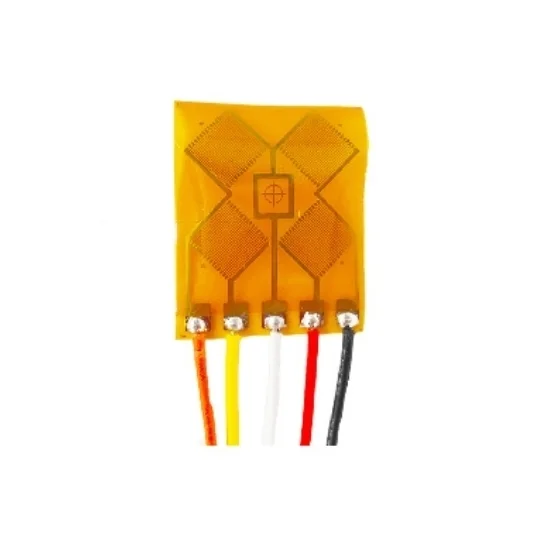
Built for durability and long-term stability, the full bridge torque strain gauge adopts constantan alloy sensitive grids combined with a phenolic resin substrate. It offers a repeatable life cycle of up to 10⁷ times, delivering excellent performance and reliability.
Specification
| Model | ATO-BF350-6EA |
| Resistance | 350Ω |
| Gauge Factor | 2.08 |
| Accuracy Class | Class A |
| Backing Material | Phenolic resin |
| Sensitive Grid Material | Constantan (CuNi alloy) |
| Sensitive Grid Size | 6*6mm |
| Backing Size | 28.5*21.5mm |
| Measuring Range | 200000με |
| Operating Temperature Range | -20℃ to +80℃ |
| Lead Length | 30cm integrated lead + 30 cm extension lead (SM plug-in connection) |
| Repeated Life | 10⁷ cycles |
| Application | Shaft torque measurement, 4× measurement sensitivity |
Features
- Full-bridge Design: Internally integrates four sensitive grids to form a complete Wheatstone bridge, significantly enhancing signal strength and measurement accuracy.
- Ultra-wide Measurement Range: Spans up to 200,000 με with a sensitivity coefficient of 2.08 ± 1%. Features low linear error and high repeatability, meeting stringent data reliability requirements for scientific research and industrial-grade testing.
- 10⁷ Cycle Life: Constructed with constantan alloy sensitive grids and phenolic resin substrates, processed through specialized encapsulation techniques, it withstands over 10⁷ dynamic cyclic loadings.
- High-stability Materials and Output: 350Ω resistance combined with constantan grids and phenolic resin backing delivers reliable, stable signal performance.
Tips: How does a torque strain gauge work?
The operating principle of torque strain gauges is based on the resistive strain effect. When a shaft experiences torque, shear strain occurs on its surface. In engineering applications, strain gauges are typically bonded at ±45° angles onto the shaft surface, converting shear strain into one set of tensile strain and one set of compressive strain. The metal sensitive grid within the strain gauge undergoes changes in length and cross-sectional area due to minute material elongation or compression, thereby altering its resistance value. This resistance change is directly proportional to the strain (ΔR/R = K·ε, where K is the sensitivity coefficient and ε is the strain). When multiple strain gauges are connected in a Wheatstone bridge configuration, particularly in a full-bridge structure, the differential voltage output from tensile and compressive resistance changes significantly enhances signal strength and temperature compensation capability. Ultimately, by combining the measured strain values with the shaft’s material mechanical parameters and geometric dimensions, the actual torque can be calculated, achieving precise conversion from mechanical deformation to electrical signal to physical quantity.
Reviews
There are no reviews yet.