
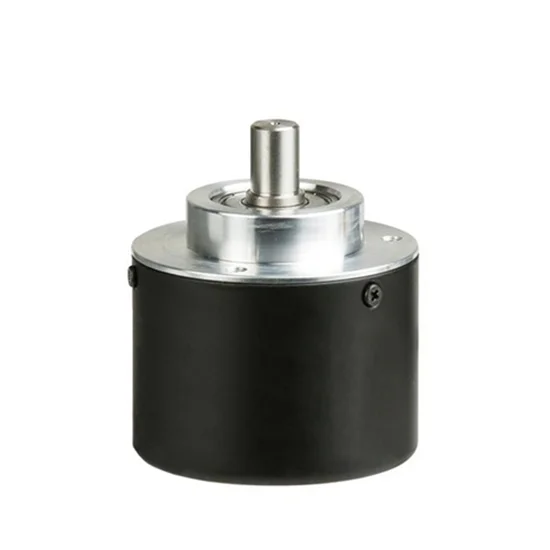
Description
Incremental optical rotary encoders with 5000 ppr can be used for robots, workbenches, injection molding machines, electronic equipment, printing and packaging machinery, non-standard equipment and CNC machine, a variety of office automation systems, industrial automation control and measurement fields.
Specification
| Basics | Model | ATO-S5808G-5000BM | |||||||
| Weight | 100 g | ||||||||
| Wiring | Color | Red | Black | Green | White | Yellow | Brown | Gray | Orange |
| Signal | Vcc | GND | A | B | Z | A- | B- | Z- | |
| Mechanical properties | Maximum shaft speed (r/min) | 5000 | |||||||
| Starting torque | <0.03Nm (25℃) | ||||||||
| Maximum shaft load | Radial load: 50N, axial load: 20N | ||||||||
| Shock resistance | 50G/11ms | ||||||||
| Anti-vibration | 10G (10~2000Hz) | ||||||||
| Rotational inertia | 4X10⁻⁸kgm2 | ||||||||
| Operating temperature | -30~+85℃ (-22~+185℉) | ||||||||
| Storage temperature | -35~+95℃ (-31~+203℉) | ||||||||
| Protection Level | IP51 | ||||||||
| Electrical characteristics | Output circuit | Open-collector output | Voltage output | Push-pull output | Line driver output | ||||
| Supply voltage Vcc | DC 5V±0.2 | DC 5~24V | DC 5V±0.2 | DC 5~24V | DC 5V±0.2 | DC 5~24V | DC5V±0.2 | DC 5~24V | |
| Current consumption | ≤60mA | ≤60mA | ≤60mA | ≤100mA | |||||
| Output high level | ≥3.5V | ≥Vcc-2.5V | – | – | ≥2.5V | ≥Vcc-2.5V | |||
| Output low level | ≤0.5V | ≤0.5V | – | – | ≤0.5V | ≤1.0V | |||
| Rise time Tr | ≤500ns | ≤1500ns | – | – | ≤200ns | ≤500ns | |||
| Fall time Tf | ≤100ns | ≤300ns | – | – | ≤200ns | ≤200ns | |||
| Maximum frequency response | 0~100kHz | 0~100kHz | 0~100kHz | 0~100kHz | 0~100kHz | 0~100kHz |
Model Selection
| Shaft type | Diameter of shell | Diameter of shaft | Connection type | Cable length * | Resolution | Production identifier | Z signal | Z signal wavelength | Output mode * | Voltage * |
| S: Shaft | 58: 58mm | 8: 8mm | G: Cable edge output | 1: 1m 2: 2m 3: 3m 4: 4m |
5000: 5000 ppr | B | M: Output 1 if receiving Z signal | Default: 1T | C: Open-collector NPN CP: Open-collector PNP T: Voltage output NPN+R P: Push-pull output NPN+PNP L: Line driver 26LS31 K: Line driver 7272 |
5: +5VDC 830: +8~30VDC |
Note: * denotes optional parameters, you can select parameters in drop-down lists to finish your order. Some customizable parameters can’t be selected from the lists directly, please contact customer service staff for further communication.
Features
- The optical shaft encoder adopts a special ASIC chip inside, which is stable and reliable in signal processing and ensures accurate output pulse.
- The overall structure is durable, long life, suitable for long time high frequency operation of industrial occasions.
- Incremental encoder has excellent anti-interference performance, can work stably in complex electromagnetic environment.
- Compact and lightweight, suitable for automation equipment with limited installation space.
- Modular design, easy installation, fast and efficient commissioning.
Dimension (unit: mm)
Application
Tips: How to use rotary encoder to detect linear displacement?
- Use a flexible coupling to connect the rotary encoder directly to the main shaft of the power unit that drives the linear displacement.
- Use a small gear (spur gears, bevel gears or worm gear) box to connect with the power unit.
- Use a gear rotating on a spur rack to transfer linear displacement information.
- Get linear displacement information on the drive chain sprocket.
- Obtain linear displacement information on the timing belt of the timing belt pulley.
- Use rotary encoders that are equipped with magnetic rollers to obtain displacement information on linear displaced flat steel surfaces (avoid slip).
- Use retractable wire assembly like a steel tape to connect the rotary encoder to detect linear displacement information (data processing need to overcome the stack winding error).
- Similar to 7, use retractable wire assembly with a small torque motor to connect a rotary encoder to detect linear displacement information (there are similar products in Germany at the moment, with a complex structure and almost no stack winding error).
Reviews
There are no reviews yet.